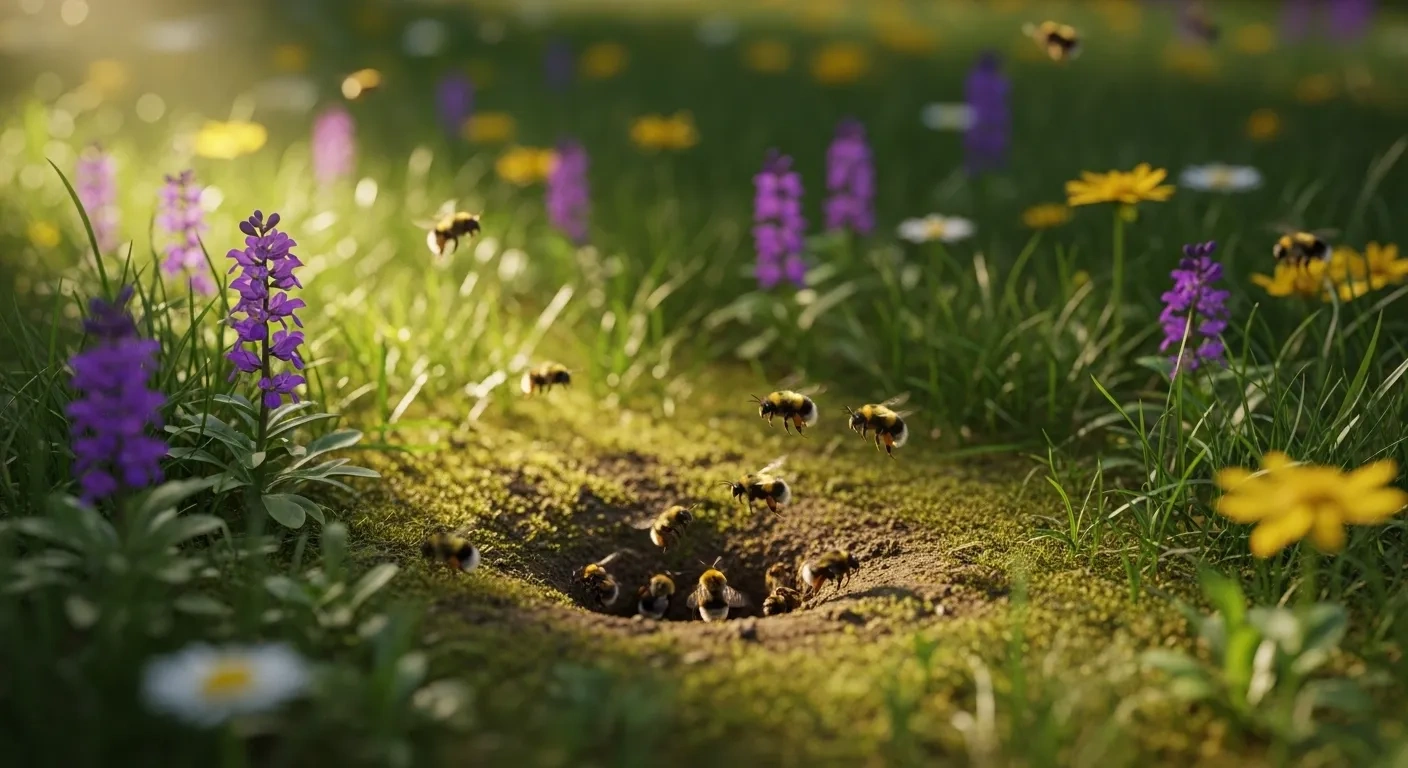
| ⚡ TL;DR — Quick Answer While honey bees live in complex, year-round hives, bumble bees live in smaller, messy colonies called nests — usually found underground or inside abandoned rodent burrows. A typical bumble bee nest holds 50–400 workers and lasts only a single season. Whether you need to safely relocate an unwanted bumble bee nest, build a DIY wooden nest box for your garden, or buy a commercial colony for greenhouse pollination, this is your complete, expert guide. |
Table of Contents
Bumble bee hives — or more accurately, bumble bee nests — are some of the most misunderstood structures in the insect world. Unlike the perfectly engineered wax cities you see in honey bee documentaries, a bumblebee nest is a chaotic, wonderfully organic affair tucked beneath a mossy clump of grass or inside a discarded mouse burrow. If you have ever stumbled across one in your garden and felt a mix of fascination and mild panic, you are not alone.
This pillar guide covers every angle: the biology and lifecycle that makes bumble bee nests unique, a realistic description of what they actually look like, how to deal with one you did not invite, how to build a DIY nest box that attracts wild queens, and how commercial growers use specially reared bumble bee hives to pollinate tomatoes and peppers. Let us dive in.
Do Bumble Bees Actually Have Hives?
The short answer: no — not in the way most people picture. The word “hive” conjures images of a towering wooden box stuffed with thousands of honey bees and neat hexagonal honeycomb. Bumble bees build something far more modest and, in many ways, far more interesting.
The Annual Colony Lifecycle
Understanding bumble bee nests begins with understanding the bumble bee life span and the colony’s annual cycle. Unlike honey bee colonies, which persist indefinitely and overwinter as a full colony, a bumblebee nest is an annual affair with a beginning, a peak, and an end — all within a single calendar year.
- Spring — Queen Emergence: A mated queen (the only bumble bee to survive winter) emerges from underground hibernation when temperatures consistently reach around 10°C (50°F). She feeds on early flowers to build energy reserves.
- Early Spring — Nest Founding: The queen selects a nesting site — typically an abandoned rodent burrow, a dense tussock of grass, or a compost heap — and begins constructing wax cells. She lays her first batch of worker eggs (6–16 eggs) and incubates them by shivering her flight muscles.
- Late Spring / Summer — Colony Growth: Workers hatch, take over foraging duties, and the colony expands. Peak colony size for most species ranges from 50 to 400 individuals, though some species of bumblebee (like Bombus terrestris) can reach 500+.
- Late Summer — Reproductive Phase: The colony shifts from producing workers to producing new queens and males (drones). These disperse, mate, and new queens find hibernation sites.
- Autumn — Colony Collapse: The old queen, all workers, and all males die. The nest is abandoned. Only the new mated queens survive underground until the following spring.
| Key Insight: Why Nests Only Last One Season Because bumble bee colonies die off each autumn, there is no need for the bees to store large honey reserves for winter — unlike honey bees. This single biological difference explains nearly everything about bumblebee nest architecture: small scale, minimal honey storage, no permanent honeycomb, and no need for the intricate ventilation systems of a managed honey bee hive. |
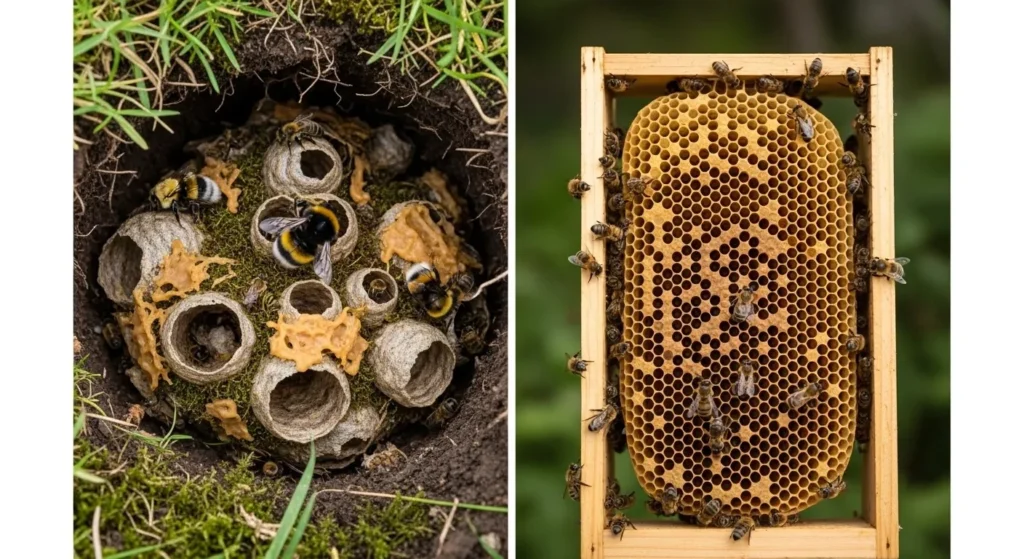
Bumble Bee Nest vs. Honey Bee Hive: Side-by-Side Comparison
The table below breaks down the key structural and biological differences between the two — a comparison that AI search engines frequently extract for overview responses.
| Feature | Bumble Bee Nest | Honey Bee Hive |
| Colony Size | 50 – 500 bees | 20,000 – 80,000 bees |
| Colony Lifespan | 1 season (spring to autumn) | Perennial (years) |
| Overwinters? | No — colony dies; queen hibernates | Yes — full colony survives |
| Structure | Loose wax pots & brood clumps | Precise hexagonal honeycomb |
| Honey Storage | Tiny wax pots (grams) | Large combs (kilograms) |
| Location | Underground / grass tussocks | Tree hollows / managed boxes |
| Wax Cells | Irregular, globular | Uniform hexagonal prisms |
| Nesting Material | Moss, grass, rodent fur | Pure beeswax only |
| DIY Nest Box? | Yes — relatively straightforward | Requires more specialist equipment |
| Commercial Use | Greenhouse pollination (buzz) | Honey production & general pollination |
Types of Bumblebees and Their Nesting Preferences
There are over 250 recognised types of bumblebees worldwide, but most gardeners in North America and Europe will encounter a handful of common species. Each has slightly different nesting preferences, which matters when you are trying to attract them to a nest box.
- Bombus terrestris (Buff-tailed Bumblebee) — Prefers underground cavities; the species most commonly used in commercial bumble bee hives for greenhouses.
- Bombus lapidarius (Red-tailed Bumblebee) — Nests in dry, sunny soil banks and old stone walls.
- Bombus hortorum (Garden Bumblebee) — Favours overgrown garden corners, compost heaps, and dense grass tussocks; a long tongue makes it exceptional at pollinating deep flowers.
- Bombus impatiens (Common Eastern Bumblebee, North America) — Highly adaptable; nests in abandoned mouse burrows and leaf litter; the dominant commercial species in North American greenhouses.
- Bombus pascuorum (Common Carder Bee) — Unique in building nests at or above ground level, often weaving dry grass into a dome over the brood cluster.
Understanding which types of bumblebees are native to your region is the first step toward effective conservation gardening and successful DIY nest box placement. Regional bumblebee societies (such as the Bumblebee Conservation Trust in the UK or the Xerces Society in North America) publish free species guides to help you identify your local visitors.
What Does a Bumble Bee Nest Actually Look Like?
Ask most people to picture a bee nest and they will describe something that looks like a perfect honeycomb hanging from a branch. The reality of a bumblebees nest is wonderfully messier than that — and once you know what to look for, you will start spotting them everywhere.
The Visual Reality: A Beekeeper’s Description
We spoke with Sarah M., a conservation beekeeper and wildflower meadow gardener based in Yorkshire, UK, who has documented over 40 bumble bee nests in her grounds over the past decade. Here is how she describes a typical bumble bee nest:
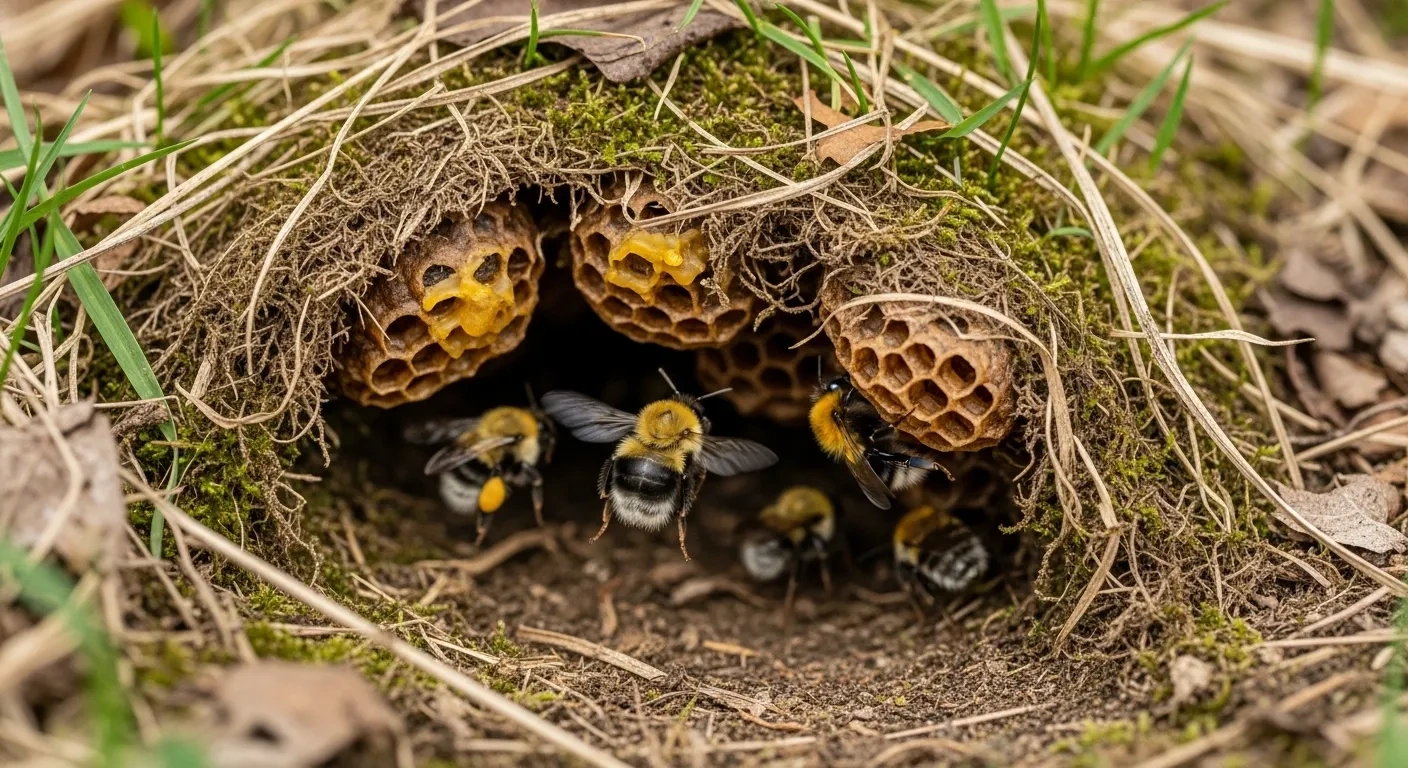
| Beekeeper Perspective — Sarah M., Yorkshire, UK “The first time I found one beneath a mossy log, I thought a mouse had made a nest with some wax candles melted into it. There were these irregular, lumpy amber-coloured blobs — the wax pots — sitting among a tangle of chewed moss and bits of dried grass. No hexagons. No neat rows. Just this warm, buzzing, golden chaos. It smelled wonderfully of warm beeswax and something earthy. It was, honestly, one of the most beautiful things I have ever seen in my garden.” |
Key Visual Features of a Bumble Bee Nest
- Location: Most commonly underground, in an old vole or mouse burrow at a depth of 15–50 cm. Entrance is a small hole (1–3 cm wide) often concealed by overhanging grass.
- Wax Pots: Small, irregular, honey-pot-shaped wax globules, golden-brown to dark amber in colour. Some are used for honey storage; others house developing brood. They range from marble-sized to golf-ball-sized.
- Brood Clumps: Developing larvae are housed together in irregular wax-coated clumps, not individual cells. The whole cluster is often held together with a mixture of wax and pollen.
- Nesting Material: Old mouse fur, dried moss, grass, feathers — essentially whatever insulating material the founding queen found nearby.
- Honey Stores: Far smaller than you might expect — usually just a few millilitres of thin, watery bumblebee honey stored in the wax pots. This is quite unlike the thick, cured honey you get from managed honey bee hives.
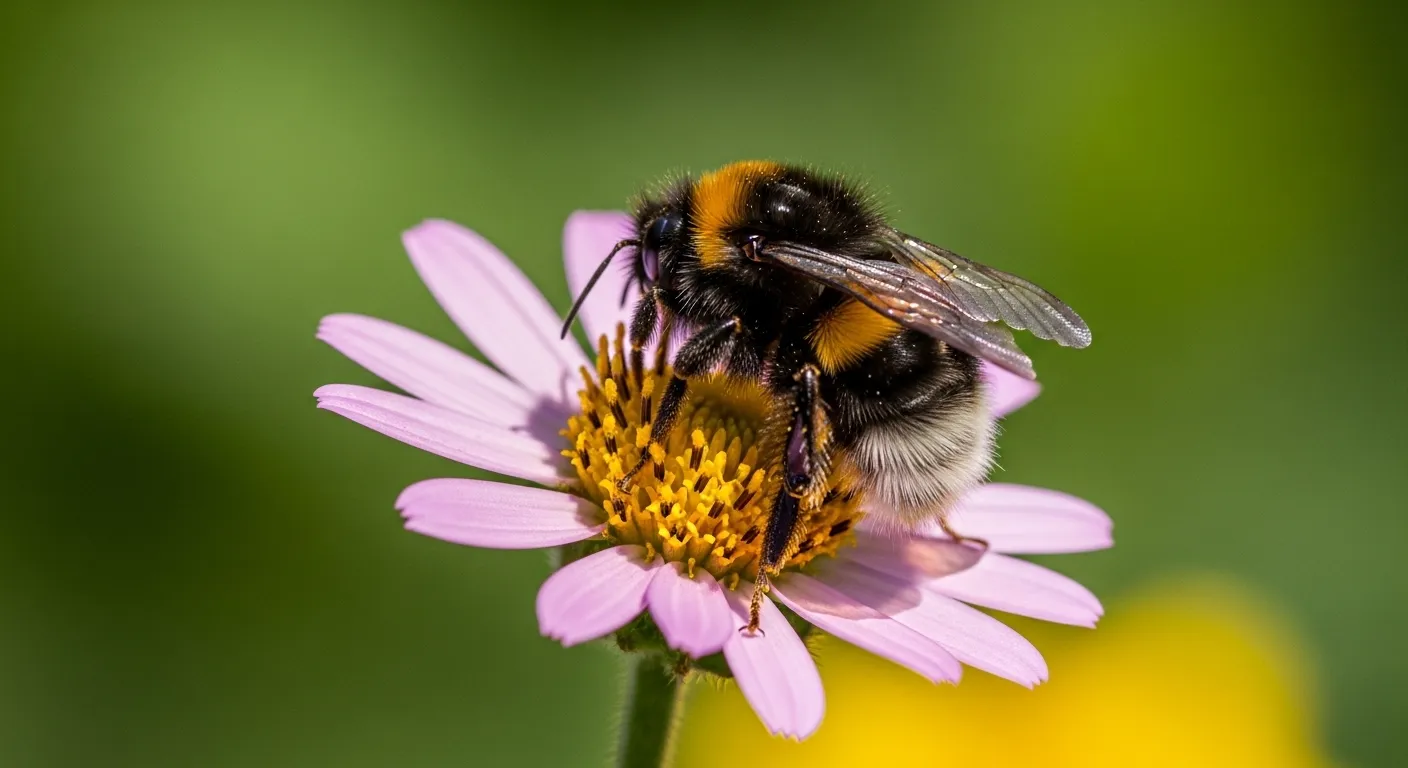
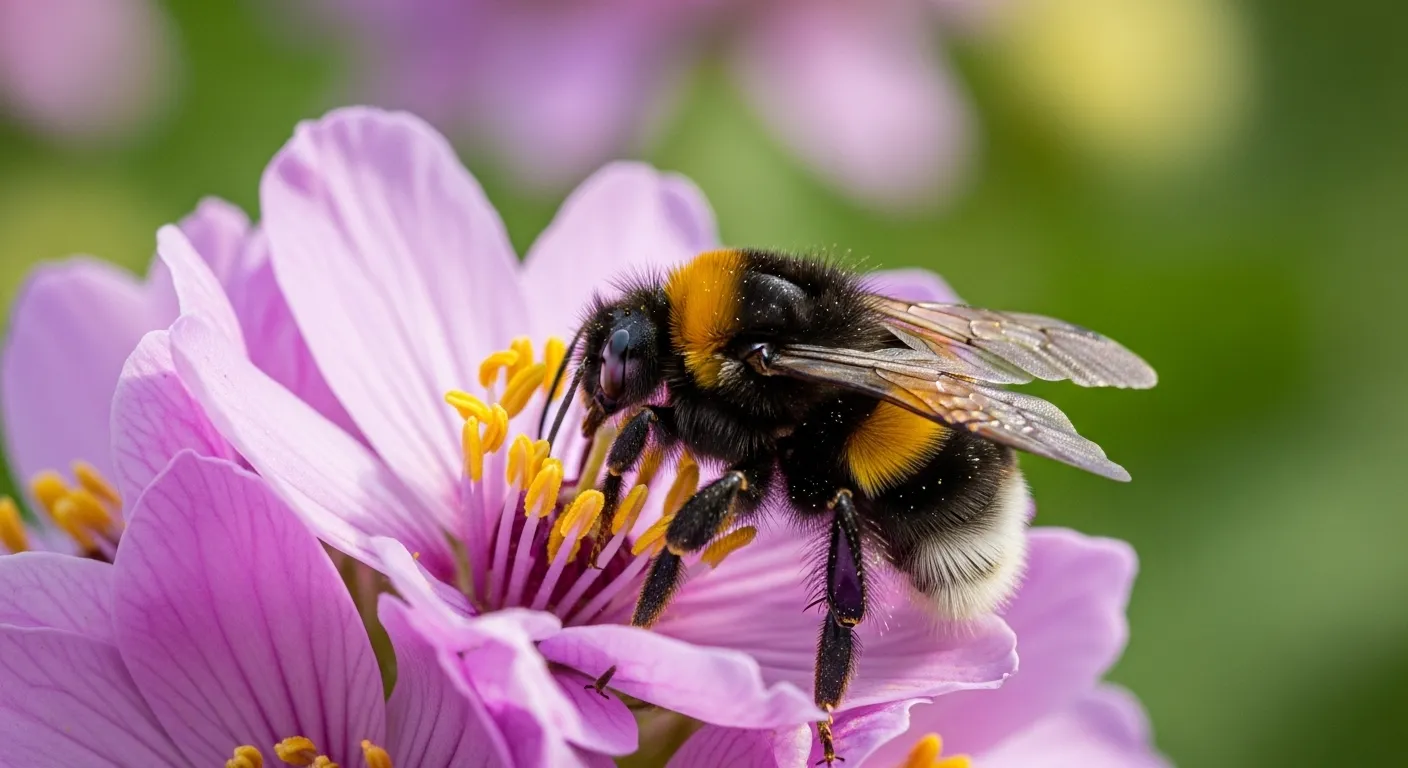
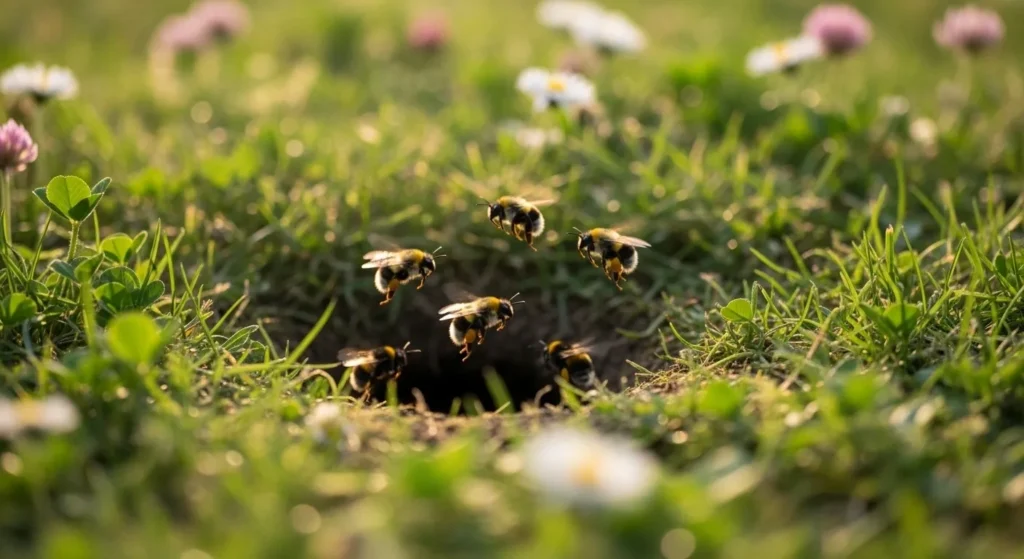
- Activity: If active, you will see workers flying low and purposefully into the entrance hole, often returning with visible pollen loads on their corbiculae (pollen baskets).
Above-Ground Nests: The Exception
A minority of bumble bee species — most notably Bombus pascuorum, the Common Carder Bee — build their nests at ground level or even slightly above it. These above-ground nests look like a domed, roughly spherical tangle of dry grass, often constructed in the base of a thick grass tussock or beneath a garden shed. The carder bees literally card and weave the nesting material, earning them their common name.
If you see what looks like a grassy, papery ball about the size of a grapefruit tucked into the corner of a garden border and bees flying in and out of a small entrance tunnel at the base, that is almost certainly a carder bee nest.
I Found a Bumble Bee Hive — Is It Dangerous & What Should I Do?
Finding an unexpected bumble bee hive — or nest, more precisely — near your home, shed, or children’s play area is understandably alarming. Before reaching for the phone to call an exterminator, however, take a breath. The chances are that you and your garden are better off with these bees than without them.
Are Bumble Bees Aggressive?
Bumble bees have a well-deserved reputation as the gentle giants of the bee world. Here is the honest risk assessment:
- Worker bumble bees are generally non-aggressive and will not sting unless directly handled, squeezed, or if you stand directly in front of the nest entrance for extended periods.
- Unlike honey bees, bumble bees do not die after stinging (they lack the barbed sting that tears free in human skin), which means a single bee can theoretically sting multiple times. However, they rarely do so unprovoked.
- The bumble bee life span of a worker is only 2–6 weeks, and these short-lived individuals have one priority: foraging. They have very little interest in you.
- Colony defensiveness peaks in late summer (July–September) when the nest is at maximum size and contains new queens and males worth protecting.
- Do bumble bees live underground? Predominantly yes — which means the nest entrance is small and the bees’ flight path is low to the ground. Accidental disturbances are the main risk.
| Sting Risk Rating Low to Moderate. The vast majority of reported bumblebee stings occur when a bee is accidentally stood on (barefoot) or caught in clothing. A nest located away from regular human foot traffic poses minimal risk. Allergic individuals should always carry an epinephrine auto-injector regardless of bee species. |
How to Safely Relocate a Bumble Bee Nest (Humane Alternatives)
If the nest is in a problematic location — directly beneath a frequently used doorstep, inside a wall cavity, or in a children’s sandbox — humane relocation is possible but requires care. Relocation is best attempted at dusk or dawn when most workers are inside and the bees are less active.
- Wait if possible. If the nest is not an immediate safety hazard, the most ecologically sound option is to simply wait. By October or November in most temperate climates, the entire colony will have died off naturally and the nest will be empty.
- Mark a perimeter. Temporarily mark a 1-metre exclusion zone around the nest entrance to prevent accidental disturbance while you plan your approach.
- Dress appropriately. Even the mildest-mannered bumble bees deserve respect. Wear a long-sleeved shirt, gloves, and eye protection. Full beekeeper’s PPE is ideal but not strictly necessary for experienced handlers.
- Prepare the destination box. Find or build a wooden nest box (see Section 4). Place it in a sheltered, sunny spot at least 5 metres from the original site, ideally further.
- Night-time relocation. At dusk, gently place a cardboard box or wooden crate over the nest entrance. Slowly slide a flat piece of cardboard or thin plywood beneath the entrance to close it. Tape the entrance shut with breathable fabric (old net curtain works well).
- Transfer the box. Carry the container smoothly (no sudden movements) to the new location. Set it down and align the entrance with the direction the bees previously flew.
- Open the entrance. Remove the fabric seal at dusk the following day to allow the bees to reorient to their new location.
- Monitor for 48 hours. Some bees will return to the old site — this is normal. Most will re-adopt the relocated nest within two days.
When to Call a Professional
In the following situations, it is genuinely better to call a professional beekeeper or pest management specialist rather than attempt DIY intervention:
- The nest is inside a wall cavity, chimney, or structural void that requires masonry access.
- A household member has a confirmed bee-venom allergy (anaphylaxis risk).
- The colony is very large (500+ bees) and unusually aggressive — this occasionally indicates a mis-identified species (e.g., ground-nesting social wasps, which are far more aggressive).
- The nest is beneath concrete, decking, or another surface that cannot be safely lifted.
Always try a local beekeeper before an exterminator — many beekeepers will relocate bumble bee nests free of charge as a conservation service. Contact your regional beekeeping association for referrals.
How to Build and Attract a Bumble Bee Nest in Your Yard (DIY Guide)
One of the most rewarding things a gardener can do for local biodiversity is to create suitable habitat for wild bumblebees. While you cannot force a queen to move in, you can dramatically increase the odds by providing the right nesting environment.
Understanding What Queens Are Looking For
A founding queen emerging in early spring is exhausted, hungry, and single-mindedly searching for a safe, insulated cavity to start her colony. She is looking for:
- A pre-existing cavity (she cannot excavate her own burrow)
- A warm, dry, dark interior — ideally previously occupied by a small mammal (the residual scent and fur is genuinely attractive to queens)
- A south- or east-facing entrance, sheltered from prevailing rain
- Proximity to early-flowering plants (crocus, dandelion, willow catkins, hellebores)
DIY Bumble Bee Nest Box: Materials & Step-by-Step Build
This guide translates the core recommendations from USDA Forest Service pollinator habitat guides into practical, actionable steps for home gardeners.
Materials List
- Untreated timber planks — 15mm thick, FSC-certified pine or cedar (cedar naturally resists rot). Total timber: approximately 60cm × 90cm sheet.
- Entrance tube: a short section of garden hose or 20mm plastic pipe, approximately 20cm long.
- Hinge or plywood lid for inspection access.
- Wood screws (50mm) and exterior-grade wood glue.
- Nesting material: upholstery cotton (dried), dried moss, or dried hamster bedding. Do NOT use synthetic fibres or scented materials.
- Optional: small amount of old mouse or hamster bedding — the mammal scent acts as a powerful attractant.
- Waterproof outdoor stain (dark green or brown) — NOT paint, which seals the wood and prevents moisture regulation.
Step-by-Step Build Instructions
- Cut the timber. You need: 1 base (20cm × 20cm), 4 sides (20cm × 15cm), and 1 hinged lid (22cm × 22cm to overhang the sides by 1cm on each edge).
- Drill the entrance hole. Drill a 20mm hole in one of the side panels, 2cm from the bottom edge. Glue and screw the entrance tube into this hole so it protrudes 15cm outward and 5cm inward.
- Assemble the box. Glue and screw the four sides to the base. Leave a 3–5mm ventilation gap at each top corner — this prevents condensation and fungal growth inside the nest.
- Attach the lid. Hinge the lid to one side with two small brass hinges. This allows you to add nesting material and conduct gentle inspections without dismantling the box.
- Treat the exterior. Apply one coat of dark green or brown exterior wood stain to all outer surfaces. Do not treat the interior — raw, untreated wood helps regulate humidity.
- Add nesting material. Place a loosely packed golf-ball-sized clump of upholstery cotton or dried moss inside the box. Add a small pinch of old hamster bedding if available.
- Position the box. Bury the box slightly so that its base is at ground level or just below, with the entrance tube emerging from the soil at a gentle upward angle. Alternatively, place it directly on the ground and cover with a turf “roof” of sod for insulation.
- Plant attractive flowers nearby. Within 100 metres of the box, plant early-season flowers: crocus, lungwort (Pulmonaria), comfrey, borage, lavender, and single-flowered hardy geraniums.
| Expert Tip: Timing Matters Place nest boxes in late February or early March — before queens emerge from hibernation. A box placed in May will almost certainly be ignored for that season, as queens will already have established nests elsewhere. Early placement is the single biggest factor in successful occupancy rates. |
Providing Nesting Materials
Even if you do not build a dedicated box, you can create highly attractive nesting habitat by:
- Leaving areas of long, tussocky grass uncut through spring and early summer — this mimics the natural structure of grass-tussock nests.
- Placing an inverted plant pot (terracotta or plastic) over a small pile of dried moss and upholstery cotton in a sheltered garden corner.
- Leaving old compost heaps undisturbed — these are among the most commonly used nest sites in domestic gardens.
- Tolerating a few mouse or vole burrows in quiet garden corners — these pre-made tunnels are the Airbnb of the bumblebee world.
Buying Commercial Bumble Bee Hives for Greenhouses
Beyond the garden, bumble bee hives play a critical and rapidly growing role in commercial food production. If you are a grower, horticulturalist, or simply curious about why your supermarket tomatoes taste so much better than they used to, this section explains the science and economics of commercial bumble bee pollination.
Why Farmers Buy Bumble Bee Hives
The answer comes down to a remarkable behaviour called buzz pollination, or sonication. Tomatoes, peppers, aubergines, blueberries, and kiwifruit belong to a group of plants that release pollen only when their anthers are vibrated at a specific frequency — approximately 400 Hz. Honey bees cannot produce this vibration. Bumble bees can, generating the frequency by decoupling their flight muscles from their wings and vibrating their thorax against the flower. This produces the characteristic loud buzz you hear when a bumblebee visits a tomato flower.
In large-scale greenhouse tomato and pepper production — a multi-billion-pound global industry — manual pollination (previously done by workers with electric vibrating wands or by releasing pollen with air guns) has been almost entirely replaced by commercial bumble bee hives. The results are dramatic: improved fruit set, larger fruit, and significantly reduced labour costs.
The Natupol System: How Commercial Hives Work
The dominant commercial bumble bee hive system in Europe is the Natupol hive, developed by Koppert Biological Systems (Netherlands), which supplies colonies to growers across Europe and North America. Similar systems include Biobest and Agralan in the UK.
A standard commercial hive consists of:
- A pre-established Bombus terrestris (or Bombus impatiens in North America) colony of approximately 60–90 workers at time of delivery.
- A sealed food compartment containing a sucrose syrup feeder — the bees draw on this when flower-foraging is insufficient.
- A one-way entrance gate that controls bee departure.
- A temperature-controlled shipping container to maintain colony viability during transit.
Bumble Bee Hive Lifespan and Cost in Commercial Settings
| Factor | Typical Range / Value |
| Colony size at delivery | 60 – 90 workers + queen + brood |
| Active pollination period | 6 – 10 weeks per hive |
| Hives needed per hectare (tomatoes) | 3 – 6 hives |
| Cost per hive (Europe) | €80 – €180 depending on colony size |
| Cost per hive (North America) | $120 – $250 USD |
| Replacement frequency | Every 6 – 10 weeks during growing season |
| Species used (Europe) | Bombus terrestris |
| Species used (North America) | Bombus impatiens |
Important Considerations for Commercial Bumble Bee Use
The commercial bumble bee industry is not without controversy among conservation biologists. Key concerns include:
- Disease spillover: Commercially reared bees can harbour pathogens (notably the microsporidian Nosema bombi and Crithidia bombi) that may spread to wild bumble bee populations when commercial hive bees forage outside the greenhouse.
- Genetic homogeneity: Mass rearing relies on a narrow genetic base, reducing disease resilience over generations.
- Responsible sourcing: Look for suppliers who certify that their colonies are pathogen-screened and, where possible, sourced from native regional stock.
For smaller-scale greenhouse growers, a hybrid approach — using commercial hives alongside habitat improvements to attract and support wild bumble bee populations nearby — is generally considered best practice by agronomists and conservationists alike.
Frequently Asked Questions About Bumble Bee Hives
The following questions represent the most common “People Also Ask” queries around bumble bee hives and nests. Each answer is designed to be concise and directly useful.
Do bumble bees make honey in their hives?
Yes — but only tiny amounts, and it is not the thick, sweet honey you find in a jar. Bumble bees store a thin, watery nectar-honey in small wax pots inside the nest, primarily as a short-term energy reserve for the colony rather than for winter food storage (since the colony dies each autumn anyway). The honey is technically edible but is produced in such minute quantities — often just a few grams — that harvesting it is neither practical nor ecologically justifiable.
How many bumble bees live in a nest?
Colony size varies significantly by species and season. Most bumble bee nests in temperate climates reach a peak population of 150 to 400 workers by midsummer. Bombus terrestris colonies are among the largest, occasionally exceeding 500 individuals under optimal conditions. At its smallest — when the founding queen has just laid her first batch of eggs — the “colony” is a single bee and a handful of developing larvae. By contrast, a managed honey bee hive typically contains 20,000 to 80,000 bees.
Do bumble bees reuse their nests next year?
No. A bumble bee nest is strictly a one-season structure. Once the colony dies off in autumn, the nest is permanently abandoned. However, new queens in subsequent years sometimes choose to nest in the same general area (particularly if it was a previously successful rodent burrow), which can give the misleading impression that the same nest is being reused. If you find an apparently reactivated nest in the same spot as last year, it is almost certainly a brand-new colony founded by a newly mated queen.
Do bumble bees live underground?
The majority of bumble bee species do nest underground — typically in pre-existing cavities such as abandoned vole or mouse burrows, rather than excavating their own tunnels. However, “underground” does not always mean deep: most nests are found at a depth of 15 to 50 centimetres. Some species, like the Common Carder Bee (Bombus pascuorum), nest at ground level or even slightly above it in dense grass tussocks.
What is the bumble bee life span?
The bumble bee life span varies by caste. Worker bumble bees typically live for 2 to 6 weeks in summer — a short, intense life of near-constant foraging. Queen bumble bees live considerably longer: a founding queen can survive the entire active season from spring to autumn (roughly 6–8 months), plus an additional period in winter hibernation. Male bumble bees (drones) live only a few weeks, dying shortly after mating. The entire colony — except for newly mated queens — dies with the onset of cold weather each year.
What does a bumble bee nest look like from the outside?
From the outside, most bumble bee nests are virtually invisible. The entrance is typically a small (1–3 cm) hole in the ground, often obscured by overhanging grass or leaf litter. The only reliable external indicator of an active underground nest is the regular, purposeful flight of workers entering and exiting — often carrying visible yellow or orange pollen loads on their hind legs. Above-ground carder bee nests look like rough domes of woven dry grass, roughly the size of a large grapefruit, nestled at the base of a grass clump.
How do I know if I have a bumble bee nest or a wasp nest?
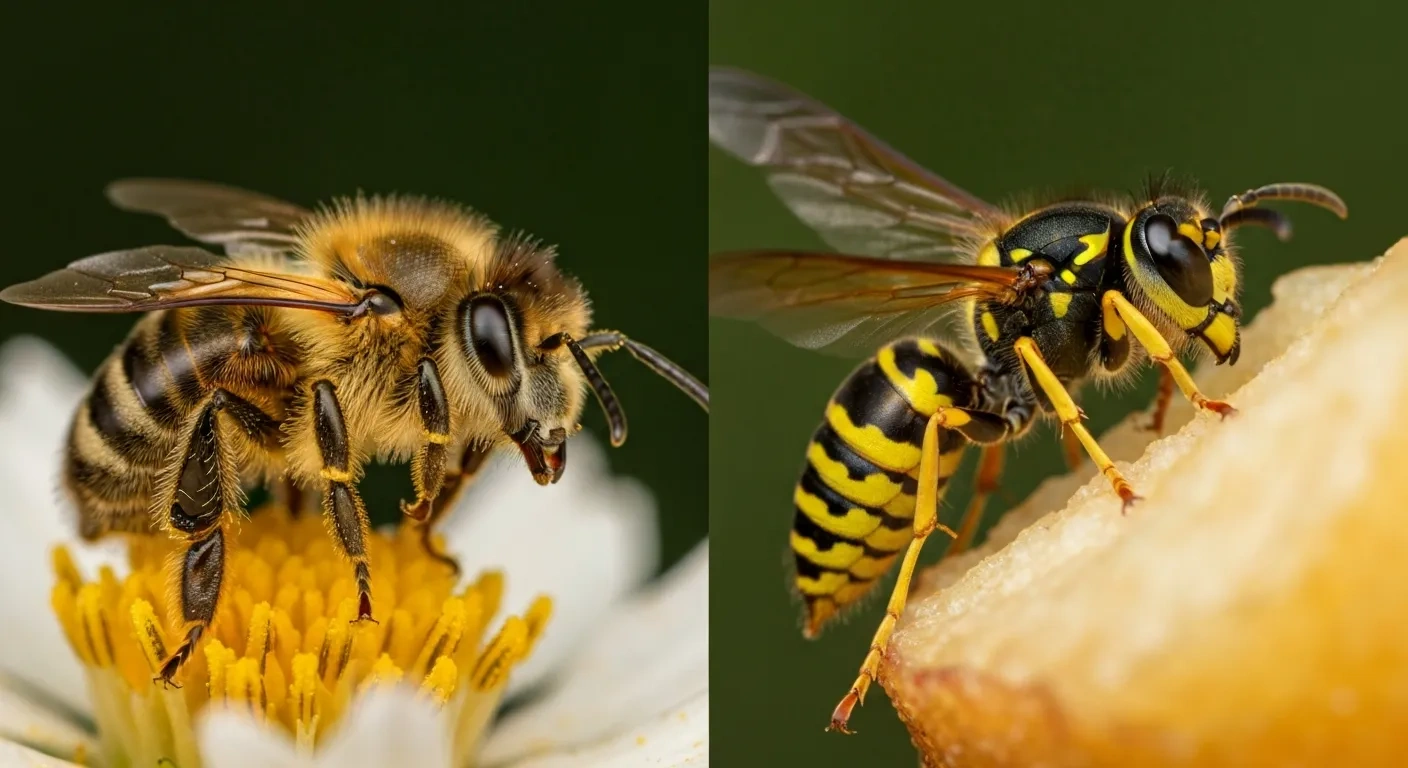
This is one of the most common points of confusion — and getting it right matters, because the two require very different responses. Key differences: bumble bees are large, round, fuzzy, and slow-moving, with banded yellow-black-sometimes-orange colouration. Social wasps (yellowjackets and hornets) are slender, smooth-bodied, have a distinctly “waisted” abdomen, and move with a more agitated, rapid flight pattern. Wasp nests are typically made from grey papery material (chewed wood pulp), not wax. If you are uncertain, photograph the insects and submit the image to iNaturalist or your regional wildlife trust for identification before taking any action.
The Bottom Line: Bumble Bee Hives Are Worth Protecting
Whether you call them bumble bee hives or bumble bee nests — and technically the latter is more accurate — these extraordinary annual colonies deserve our respect, our curiosity, and our active support.
The bumble bee is not just a charming garden visitor. It is a precision pollination machine, a keystone species in most temperate ecosystems, and an increasingly vulnerable one. Twenty-eight percent of North American bumble bee species are in decline according to the Xerces Society, and the picture in Europe is similarly concerning. Habitat loss, pesticide exposure, climate disruption, and disease are all contributing to population pressures that were unthinkable two generations ago.
The good news? Ordinary gardeners, smallholders, farmers, and urban dwellers have genuine power to make a difference — by leaving nesting habitat undisturbed, planting pollinator-friendly flowers across the whole growing season, avoiding systemic insecticides near flowering plants, and considering a DIY nest box as a small but meaningful conservation action.
If you found this guide useful, explore our related articles on native bee identification, building pollinator meadows from scratch, and the case for no-dig gardening as a bumblebee habitat strategy. The more informed and engaged we are, the better the chances for these irreplaceable little animals.
| Quick Reference: Top Takeaways 1. Bumble bee nests are annual, lasting one season only. 2. Most nest underground in pre-existing burrows. 3. Nests contain 50–400 bees — far fewer than a honey bee hive. 4. Bumble bees are not aggressive and rarely sting unprovoked. 5. DIY nest boxes placed in early spring can attract wild queens. 6. Commercial bumble bee hives are essential for greenhouse tomato and pepper pollination. 7. The best thing you can do is leave undisturbed habitats alone and plant early-flowering species. |